
Three common forms of task paralysis
| Type | What it feels like | What often helps |
|---|---|---|
| Overwhelm paralysis | So many tasks that you cannot pick one, so you do none | Write everything down, then pick one task by a simple rule |
| Choice paralysis | Stuck deciding how or where to start | Decide in advance; limit options to two |
| Perfection or fear paralysis | Avoiding a task because it might go badly | Aim for a deliberately rough first version |
| Transition paralysis | Unable to stop one thing and start the next | Use timers and a short bridging action between tasks |
What is ADHD paralysis?
ADHD paralysis is an informal name for a very common experience: freezing when you need to act. You may sit on the sofa for an hour knowing exactly what needs doing, scroll your phone while the task list grows, or spend a whole morning unable to choose which of three urgent jobs to start. It is not a clinical term and it does not appear in the diagnostic manuals. It is a description people with ADHD, and people who struggle with executive skills for other reasons, use for the moment where intention and action disconnect. The searches for "task paralysis" and "ADHD paralysis" describe the same thing. The frozen state is usually not calm. People describe a racing mind, guilt, restlessness and a sense of being trapped, which is why time spent stuck rarely feels like rest. It can also be confusing for the people around you. The same person who freezes over a two line email may handle a real crisis calmly and quickly, because urgency supplies the push that ordinary tasks lack. That inconsistency is part of the pattern, not evidence that you could simply do it if you cared more.
What a stuck day looks like, and what lies underneath
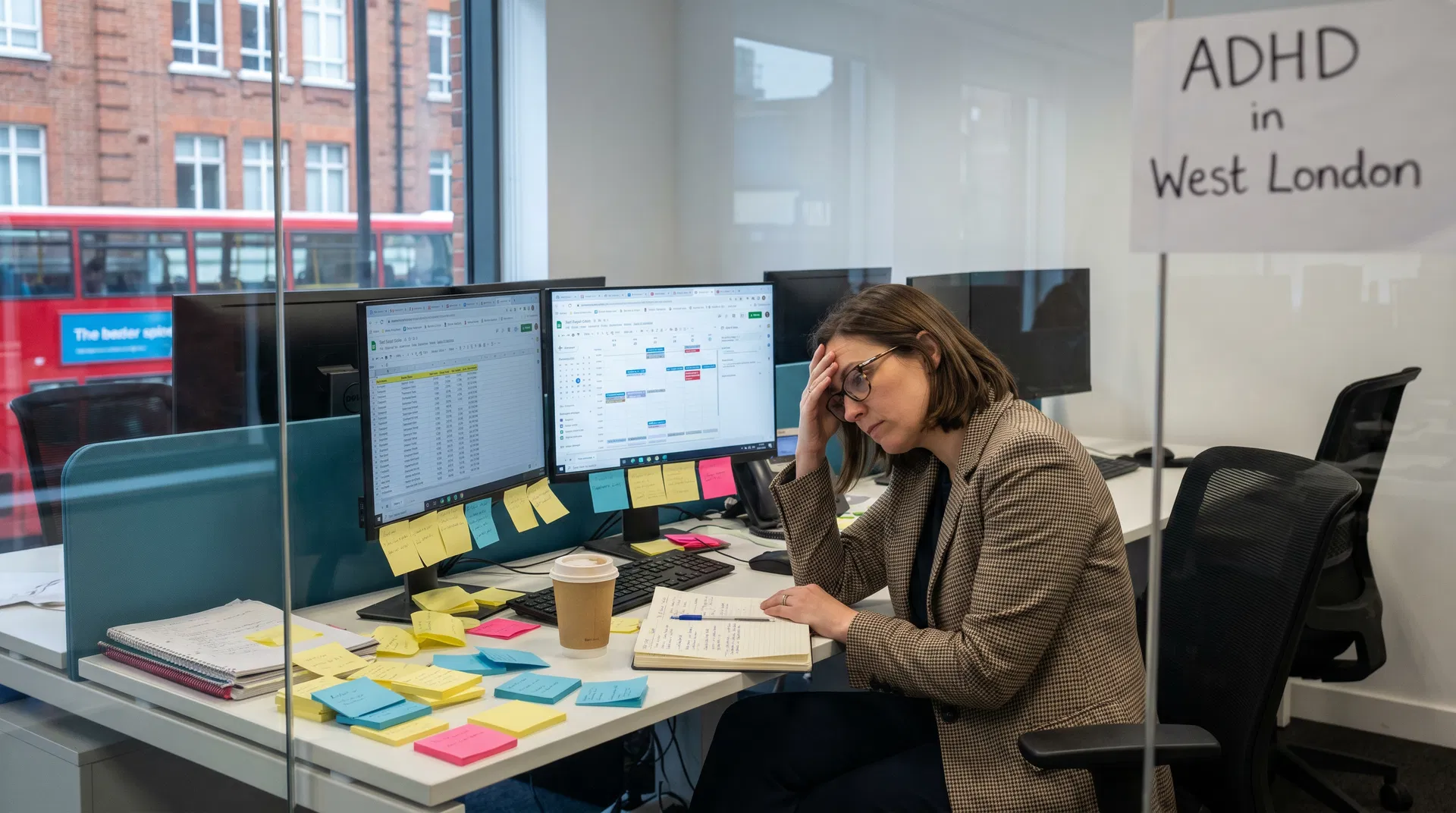
People describe staring at a short list of three chores, feeling physically heavy, freezing, and losing hours scrolling out of sheer overwhelm. The first change is moving away from big task blocks to very small, five minute steps with clear cues for moving on. Perfectionism or fear of judgement is very often underneath. Many neurodivergent adults mask heavily, so the paralysis is fuelled by fear of doing the task imperfectly or being seen to fail.
What does ADHD paralysis feel like?
Common descriptions include: feeling physically stuck in place; knowing you need to get up but not being able to make your body move; being unable to choose between tasks so doing none; getting lost in small, easy activities to avoid the big one; and feeling an intense wave of overwhelm when you look at the full list. It often comes with self talk that makes it worse. Thoughts such as "I always do this", "what is wrong with me" or "it is too late now anyway" add shame to the original difficulty, and shame tends to deepen the freeze rather than break it. Some people describe a version linked to waiting: if there is an appointment at 3pm, the whole day before it feels unusable. This is sometimes called waiting mode, and it reflects how hard it can be to plan around a fixed point in time.
Why does task paralysis happen?
Several processes tend to combine. The first is difficulty with task initiation, the executive skill of getting started. A meta analysis by Willcutt and colleagues found that groups with ADHD show weaknesses across executive skills such as planning, working memory and response inhibition, which are exactly the skills needed to turn a heap of tasks into a sequence of actions. The second is overload. When working memory is stretched, holding several tasks in mind at once is genuinely hard, so the brain experiences the whole list as one undivided weight. The third is low signal from the task itself. Research on procrastination reviewed by Steel found that task aversiveness, a long delay before consequences and impulsiveness are among the strongest predictors of putting things off. Tasks that are boring, unclear or far off give very little pull. The fourth is emotional. After years of missed deadlines and criticism, many tasks come wrapped in anxiety about failing or being judged. Avoiding the task brings short term relief, which makes avoidance more likely next time.
Is task paralysis only an ADHD thing?
No. Task paralysis is common in ADHD, but it also happens with depression, where low energy and hopelessness make everything feel effortful; with anxiety and perfectionism, where fear of getting it wrong blocks starting; with autism, where transitions and unclear instructions can be particularly hard; and with burnout, where reserves are simply depleted. The experience can look the same from the outside while the cause differs. This matters because the most helpful strategy depends on the cause. Someone frozen by perfectionism needs something different from someone frozen by exhaustion. An assessment helps work that out. A useful self question is whether the paralysis is new or lifelong. Difficulty starting tasks that has been present since school, across many settings, points in a different direction from paralysis that began during a period of stress, grief or low mood. If it is new and comes with other changes, such as poor sleep, loss of interest or physical symptoms, see your GP first.
How do you break ADHD paralysis in the moment?
Start by noticing what is happening and naming it without judgement: "I am stuck." Then aim to change your state, not to solve the whole list. Shrink the first step until it is almost too small to refuse: put your shoes on, open the laptop, write one sentence. Starting is usually the hardest part, and once you are moving, continuing is easier. Cut the choices: if several tasks are competing, pick one by a simple rule, such as the shortest or the most overdue, rather than the most important. Make time visible with a timer, and commit to just ten minutes. Change your body position or location, because physical movement often loosens a mental freeze. Body doubling, working alongside another person in the room or on a call, helps many people. If you notice you have been stuck for a long time, it is not too late. The next small action is still the right move.
How do you prevent task paralysis?
Prevention mostly means doing the hard thinking before the moment of action. Keep a single trusted list rather than tasks scattered across notes, emails and memory. At the end of each day, choose tomorrow's first task and leave everything ready for it. Break large projects into specific next actions written as verbs, such as "email Sarah about the date" rather than "wedding". Build routines that reduce decisions: the same time and place for admin each week, a fixed order for the morning. Add urgency and interest where they are missing, through deadlines shared with someone else, rewards after a task or music while you work. Look after the basics. Poor sleep, skipped meals and constant overload all make paralysis more likely, and it is easier to prevent a freeze when you are not already depleted.
Why does ADHD paralysis come with so much guilt?
Being stuck is uncomfortable, but for many people the worst part is what comes afterwards: the sense of having wasted the day, let people down or proved, once again, that something is wrong with them. That guilt is understandable. It is also one of the things that keeps the cycle going. When a task becomes linked with shame, the brain starts to treat it as a threat. Avoiding it brings brief relief, and relief teaches the brain to avoid again. The next time the task comes up, it carries the original difficulty plus the accumulated weight of every previous failed attempt. This is why the oldest, most overdue tasks often feel the heaviest, even when they are objectively small. Breaking the cycle usually means separating your worth from your output. A stuck afternoon is information about what made the task hard, not a verdict on you as a person. Treating it with curiosity rather than criticism makes the next attempt more likely to succeed.
Can CBT help with ADHD paralysis?
Yes. CBT for adult ADHD is practical and structured. It teaches organisation, planning and task breaking skills, and it works directly on the avoidance and unhelpful thinking that keep the freeze going. In a randomised controlled trial, Safren and colleagues found that CBT improved ADHD symptoms in adults who were already on medication but still struggling, with gains maintained at a 12 month follow up. Solanto and colleagues found that meta cognitive therapy targeting time management, organisation and planning improved inattention compared with supportive therapy. NICE guidance on ADHD includes psychological treatment as an option for adults. Therapy is not about being told to try harder. It is about finding out what specifically stops you starting and building systems around that.
Task paralysis in practice: an anonymised example
This is an anonymised example from the clinical practice of Sanah Younis, Founder and Clinical Director. Identifying details have been changed to protect confidentiality, and each person's treatment is planned around them. A creative professional came to therapy after missing work deadlines. They wanted to work, but spent whole days frozen and scrolling on their phone. We reframed the paralysis: not laziness, but trying to run a high demand programme on an operating system with a faulty dopamine clutch. Together we built external support: body doubling, breaking each deliverable into five minute micro steps, and clear cues for moving from one task to the next. Alongside this, self compassion work helped interrupt the shame spirals that followed a stuck day. The client regained working momentum without tipping into burnout.
How The Lyceum can help with task paralysis
The Lyceum's ADHD support is non diagnostic and non prescribing. We do not diagnose ADHD or prescribe medication. If you want an ADHD assessment or medication review, your GP or a psychiatric assessment service is the right starting point. We offer CBT that begins with an assessment of what is driving the paralysis, whether ADHD traits, perfectionism, anxiety, low mood or burnout. Therapy then focuses on practical tools for starting and switching tasks and on the self criticism that tends to deepen the freeze. Sessions are available face to face in West London and Kensington or online across the UK. If you would like to explore whether this is a fit, Book a free consultation. If you would like support, you can read about our ADHD therapy. You may also find our guide to executive dysfunction helpful.
Clinical Observation
"Body doubling, working alongside someone else or in a virtual co working space, or externalising the next step works wonders. Generic productivity tips like 'just use a planner' or 'try harder' cause immediate shame and failure."
Sanah Younis, Founder and Clinical Director of The Lyceum Clinic and a BABCP accredited Cognitive Behavioural Therapist, The Lyceum Clinic, West London
The Lyceum Clinic
Private CBT with a BABCP accredited therapist. Enquire to discuss current options, relevant referral or funding questions, and whether this support may be suitable. Face to face in West London (Chiswick, Ealing and Richmond) and Kensington, or online across the UK. £110 online · £140 face to face.
If You Need Urgent Support
- Call 999 or go to your nearest A&E if you or someone else is in immediate danger
- Samaritans: call 116 123, free, 24/7
- Shout: text 85258, free, 24/7 crisis text support
This article is for general informational purposes and does not constitute medical, legal, or diagnostic advice. It is not a substitute for a consultation with a qualified healthcare professional. Statistics cited are drawn from publicly available research and are accurate as of the date of publication. Last clinically reviewed: November 2026 by Sanah Younis, Founder and Clinical Director of The Lyceum Clinic and a BABCP accredited Cognitive Behavioural Therapist.